VetLingua
A corpus-based academic writing assistant for veterinary medicine researchers.
What is VetLingua?
VetLingua is a free AI-powered language tool built on a specialised corpus of published veterinary research articles. It is designed to help researchers explore and understand the linguistic conventions of academic writing in veterinary medicine — not just what to write, but how professionals in the field write.
Unlike general writing assistants, VetLingua is grounded in real corpus data. Every response is informed by the patterns, vocabulary, hedging strategies, reporting verbs, and rhetorical structures found in actual peer-reviewed veterinary research.
Who is it for?
Novice researchers
Early-career academics and postgraduate students writing their first veterinary research articles.
Non-native English speakers
Researchers whose first language is not English and who want to write with field-authentic language.
Corpus linguistics learners
Anyone curious about the language of veterinary medicine — its collocations, genre conventions, and discourse patterns.
Writing instructors
EAP and academic writing teachers who support veterinary students with discipline-specific writing.
What makes VetLingua unique?
Built on a real, discipline-specific corpus
Unlike general AI tools, VetLingua draws exclusively from a curated corpus of peer-reviewed veterinary research articles — compiled and structured for a PhD thesis and validated in published research.
Generates, never copies
VetLingua does not retrieve sentences from the corpus. It analyses linguistic patterns and generates entirely new, authentic-sounding examples that reflect how experts in the field actually write.
Multilingual by design
VetLingua detects the language of each query and responds in that same language — making it accessible to researchers worldwide regardless of their English proficiency.
Topic-aware navigation
Users can select from 17 topic areas — from bacterial diseases to veterinary surgery — to focus their queries on the most relevant slice of the corpus.
Completely free
100 free queries per session, no sign-up, no subscription. Built by a researcher, for researchers.
About the corpus
The Veterinary Medicine Corpus (VMC) is a machine-generated collection of high-quality, open-access research articles published between 2010 and 2022. Compiled using AntCorGen via the PLOS API, it captures complete articles with structural consistency across five sections: abstract, introduction, materials and methodology, results and discussion, and conclusion.
The VMC comprises 1,449 articles and 7,962,021 tokens, organised into 4 parent categories and 17 child categories with expert guidance to ensure scientifically meaningful classification:
Pre-clinic (n=352)
Epidemiology · Veterinary microbiology · Veterinary parasitology · Veterinary pathology · Pharmaceutics & pharmacology · Veterinary virology
Internal Medicine (n=426)
Veterinarians · Veterinary biometry · Veterinary diagnostics · Veterinary hospitals · Veterinary medicine · Veterinary surgery
Zootechnics (n=121)
Livestock care and wildlife sciences
Veterinary Diseases (n=550)
Bacterial diseases · Parasitic diseases · Viral diseases · Other
How to cite VetLingua
Özer, M. (2026). VetLingua: A corpus-based academic writing assistant for veterinary medicine (2.1). Zenodo. https://doi.org/10.5281/zenodo.19642810
Privacy & your data
What VetLingua collects
Once you create an account, VetLingua records the interactions you have with the tool — the queries you ask, the AI's responses, your vocabulary-exercise answers, and the text you submit for writing feedback (together with the corrected/improved version). It also records lightweight usage signals: which module you're in, how long you spend there, and which language and role you're using. Your account also stores the country, preferred language, role, and optional native-language you gave at sign-up.
Why
This data is used, in de-identified/aggregated form, for an academic research study on veterinary English learning. It also lets VetLingua tailor its responses to your language and role. It is not sold, and it is not used to advertise to you.
Your rights
You choose to take part when you check the consent box at sign-up, and you can change your mind at any time. From Settings you can download a copy of everything recorded under your account, or permanently delete your account and all associated data — this cannot be undone. If you are in the European Union (including Spain), this reflects the access, portability and erasure rights you have under the GDPR.
Questions
Use the Contact us form for any question about how your data is used.
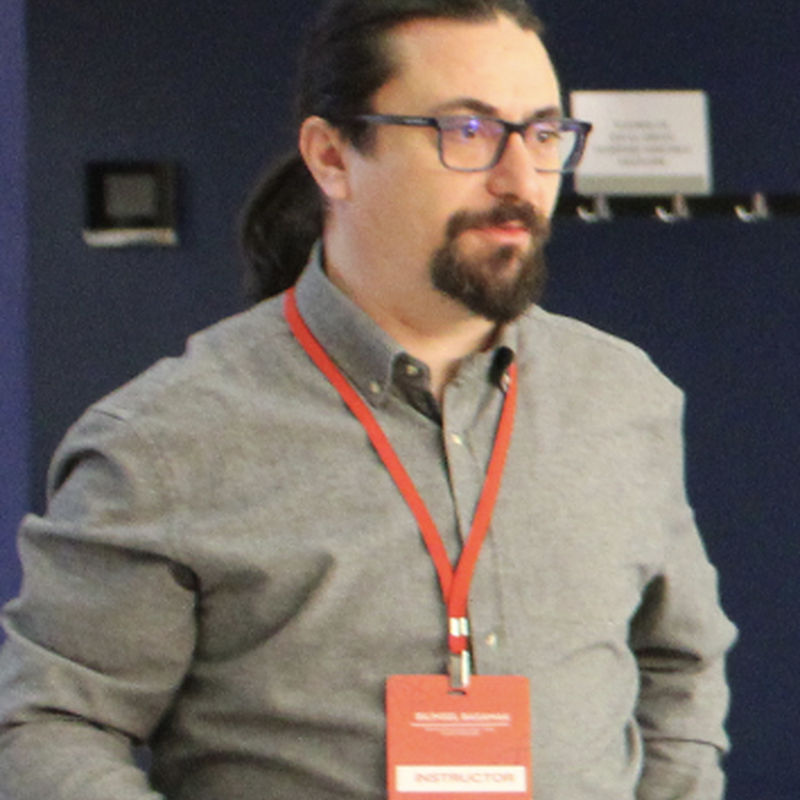
Dr. Mustafa ÖZER
Lecturer & Researcher
School of Foreign Languages
Abdullah Gül University, Kayseri, Türkiye
About the developer
Dr. Mustafa Özer is a lecturer and researcher at the School of Foreign Languages, Abdullah Gül University. His research sits at the intersection of corpus linguistics, English for Specific Purposes (ESP), data-driven learning (DDL), and academic writing — with a particular focus on the language of veterinary medicine.
VetLingua grew directly out of the corpus Dr. Özer compiled for his PhD thesis — a carefully structured collection of peer-reviewed veterinary research articles spanning 17 topic areas. The compilation methodology and the Veterinary Medicine Academic Word List derived from it are documented in a peer-reviewed article published in English for Specific Purposes (2024).
By making this corpus accessible through an AI-powered interface, Dr. Özer aims to bridge the gap between corpus linguistics research and the practical writing needs of veterinary researchers worldwide. He has been an English Language instructor since 2005 and serves as an Associate Editor at FOCUS on ELT Journal.
Education
2019–2025
PhD in Applied Linguistics
Erciyes University · Teaching Discipline-Specific Academic Writing through Corpus Pedagogy
2016–2019
MA in Applied Linguistics
Karadeniz Technical University
2001–2005
BA in Foreign Language Education
Anadolu University, Faculty of Education
Selected publications
SSCI · English for Specific Purposes, 2024
Assembling a justified list of academic words in veterinary medicine: The veterinary medicine academic word list (VMAWL)
Özer M. & Akbaş E. · English for Specific Purposes, 74, 29–43
SSCI · Education and Information Technologies, 2020
Fostering intuitive competence in L2 for a better performance in EAP writing through fraze.it in a Turkish context
Çakır İ. & Özer M. · Vol. 25(6), 5405–5426
Peer-reviewed · Australian Journal of Applied Linguistics, 2022
Exploring the data-driven approach to grammar instruction in the ELT context of Turkey
Özer M. & Özbay A.Ş. · Vol. 5(2), 35–63
Book chapter · Routledge, 2024
EAP through the lens of corpus linguistics: specifying the focus
Özer M. · in Crosthwaite P. (Ed.), Corpora for Language Learning: bridging the Research-Practice Divide, Routledge, pp. 254–255
Research interests & roles
Corpus linguistics
Data-driven learning (DDL)
EAP / ESP writing
Discipline-specific vocabulary
Veterinary academic English
Autonomous learning
EDITOR
Associate Editor — FOCUS on ELT Journal (2021–present)
GROUP
SWADA Research Group — Spoken and Written Academic Discourse Analysis, Erciyes University (2023–present)